Eighteenth lecture
The Department of Economics
The Grunberg Lecture Series
Eighteenth Lecture - April 23, 2008:
![]() |
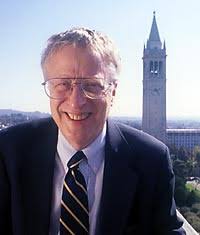
| Dr. George Akerlof Professor of Economics University of California, Berkeley Nobel Prize in Economics, 2001 |
Professor Akerlof received the Nobel Prize, along with colleagues Michael Spence and Joseph Stiglitz, for his research on asymmetric information. His seminal paper in this area was his “Market for Lemons” study which deals with the market for defective used cars (‘lemons”) but has widespread applications in other areas.
In his lecture Dr. Akerlof is expected to focus how the sense of “who people are and how they think they should behave” can affect economic outcomes. These ideas incorporate the psychology and sociology notion of “identity” in challenging mainstream assumptions about human behavior in economic analysis. For example, the inclusion of identity in models of gender discrimination in the workplace, the economics of poverty and social exclusion, and the household division of labor, can lead to significantly different conclusions from earlier economic analysis.
- George Akerlof CV (2005)
- Nobel Press Release 2001
- Information on 2001 Prize
- Akerlof's Comments
- Economics and Identity
- Quarterly Journal of Economics (August 2000)
- Journal of Economic Literature (December 2002)
- Journal of Economic Perspectives (2005)
(Click a lecture for more information.)
- The First Lecture, 1988, Herbert A. Simon (Nobel 1978)
- The Second Lecture, 1989, William Cooper (Von Neumann Medal 1982)
- The Third Lecture, 1990, Franco Modigliani (Nobel 1985)
- The Fourth Lecture, 1991, Richard Cyret
- The Fifth Lecture, 1992, James Tobin (Nobel 1981)
- The Sixth Lecture, 1993, Robert Solow (Nobel 1987)
- The Seventh Lecture, 1994, Kenneth Arrow (Nobel 1972)
- The Eight Lecture, 1995, Lawrence Klein (Nobel 1980)
- The Ninth Lecture, 1996, Harry M. Markowitz (Nobel 1990)
- The Tenth Lecture, 1997, Douglas C. North (Nobel 1993)
- The Eleventh Lecture, 1998, James A. Mirrlees (Nobel 1996)
- The Twelfth Lecture, 1999, Robert W. Fogel (Nobel 1993)
- The Thirteenth Lecture, 2000, Herbert A. Simon (Nobel 1977)
- The Fourteenth Lecture, 2001, Joseph Stiglitz (Nobel 2001)
- The Fifteenth Lecture, 2002, James A. Heckman (Nobel 2000)
- The Sixthteenth Lecture, 2004, Vernon L. Smith (Nobel 2002)
- The Seventeenth Lecture, 2006, Finn Kydland (Nobel 2004)