Academic programs

Our Undergraduate Programs

A note about degree requirements

Students must fulfill the University's General Education Requirements in addition to the requirements for their major. To find the requirements for each major, follow the link below for the major of your interest.

Biomedical Engineering

Biomedical Engineering is a rapidly growing field. New companies are being developed each month. The job outlook is excellent. A graduate will also be prepared to enter graduate study in Engineering, Law, or medical school. There are three tracks in Biomedical Engineering:

Biomechanics Track
The Biomechanics track is designed for those students who would pursue a Mechanical Engineering background with specialization in the areas of cardiovascular, orthopedic, rehabilitation engineering and system simulations.

 Biomaterials and Tissue Engineering Track
For students who would pursue a Mechanical Engineering background with specialization in the areas of cardiovascular, orthopedic, rehabilitation engineering and system simulations.

 Instrumentation, Signals and Imaging Track
For students who wish to pursue an Electrical Engineering background with specialization in biomedical instrumentation, signal and image processing, imaging devices, detectors and system simulations.


Chemical Engineering and Biomolecular Engineering

Chemical engineers enjoy every kind of employment. Most are concerned with complex industrial systems and are in demand by all segments of our society. Pharmaceuticals, polymers, petrochemicals, paints, paper, nuclear power, packaging, soap, textiles, tires, and beer are just a few of the materials which Chemical Engineers create, improve, produce, and sell.


Civil Engineering

Civil engineers find a wide range of employment opportunities. Civil engineers are employed by federal, state, county, and city governments. Others work for engineering consultants as designers, construction companies, transportation agencies and companies, oil and other energy companies, and for industrial companies as designers and managers of facilities.


Computer Engineering

Computer engineering applies computer technology along with traditional engineering science to address systems in which computing is an essential function. Such systems include the smart device or instrument, the flexible manufacturing system, and communication systems that characterize the information age. Computer engineering covers a demanding range of science and technology, combining software with hardware, and the discrete with the continuous.


Electrical Engineering

The wide-ranging uses of electrical means for measurement, control, and computation has resulted in the need for electrical engineers in all types of industries. A student seeking employment upon graduation will find many varied opportunities.


Mechanical Engineering

Mechanical Engineering is a branch of engineering concerned with the production, transmission, and storage of energy and motion and the design and analysis of physical systems to carry out these objectives. The curriculum is based on a firm grounding in mathematics and physical sciences with further study in the engineering sciences and design including solid mechanics, thermal sciences, control systems, fluid flow, energy system design and mechanical system design.


Mechanical Polymer Engineering

Engineering design experiences begin early in the curriculum and are integrated throughout, culminating in design and computer experience based on knowledge and skills acquired in earlier coursework and incorporating engineering standards and realistic constraints such as economics, health, and safety.


College of Engineering icon

The University of Akron
College of Engineering
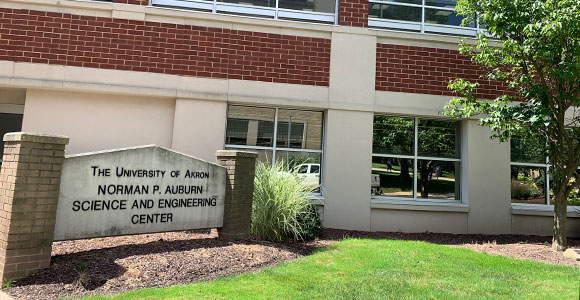
Auburn Science & Engineering Center
Akron, OH 44325-3901

Tel: 330-972-6978
Fax: 330-972-5162

The University of Akron

Akron, OH 44325
Phone: 330-972-7111
Contact us
Send mail & deliveries to UA
Text-Only