
Research Interests
Vibrational Spectroscopy and Dynamics
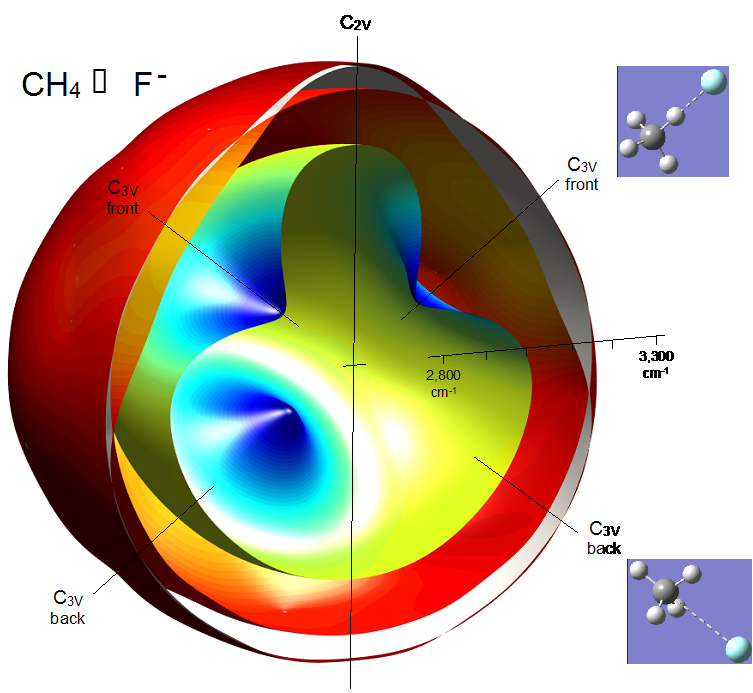
Our group studies the vibrational spectroscopy and dynamics of flexible molecules that exhibit large-amplitude motion. Such large-amplitude motion, which causes a breakdown of the usual assumptions of vibrational spectroscopy, is the key to chemical change, including conformational change and bimolecular reactions. Current projects in thisarea include far-infrared spectroscopy on CH3NO2 and CH3SH using synchrotron radiation at the Canadian Light Source. We also engage in molecular structure calculations and simulations of vibrational dynamics. When viewed as adiabatic functions in the large-amplitude coordinate space, the high frequency vibrations form potential energy surfaces that may intersect in vibrational conical intersections (figure below). The dynamics of the crossings between such surfaces is a new area of interest.
Organic Solar Photovoltaics
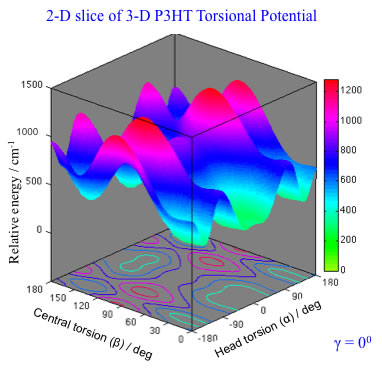
We engage in molecular structure calculations on the organic polymers used for solar energy conversion. Large-amplitude torsional motion along a conjugated backbone of the polymer disrupts the extended conjugation and degrades the efficiency of the conversion of light energy to electrical energy. Our calculations are aimed at understanding the torsional potentials (figure) and electronic properties of these polymers and to help design more efficient materials for solar energy conversion. This project is a collaboration with Prof. Mesfin Tsige of the department of Polymer Science.
Sub-Surface Soil Spectroscopy: Applications to Archaeology and Forensics
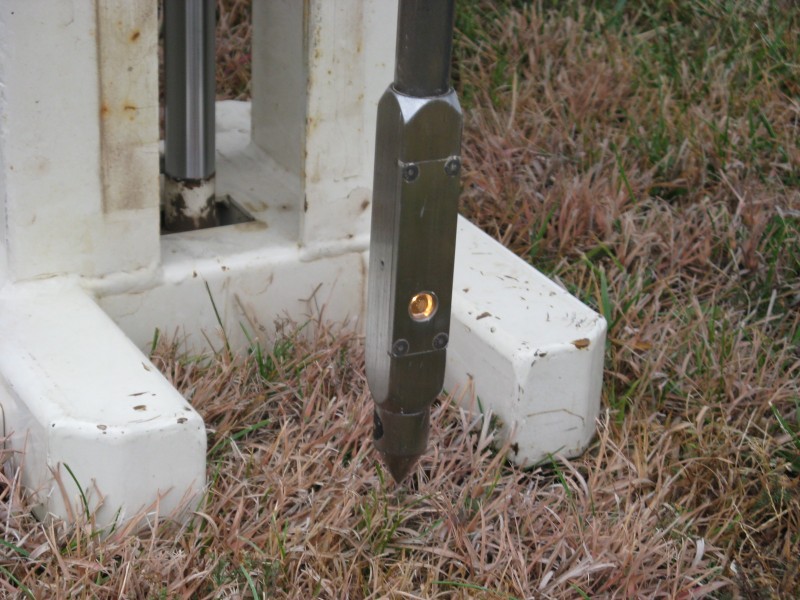
A spectroscopic probe (figure) is inserted up to a meter into the ground to record visible and near-infrared reflectance spectra as a function of depth. This technique may is used to survey the chemistry of an archaeological site as an aid to planning the excavation or to document the content of native peoples sites so that they can be given protected status. Applications to forensics are also being developed. This project is a collaboration with Professors Timothy Matney (Anthropology) and Linda Barrett (Geosciences).
Selected Publications
-
Ram Bhatta, Mesfin Tsige, and David Perry, Torsionally-induced blue-shift of the band gap in poly(3-hexylthiophene), J. Compt. Theor. Nanosc. 11, 1-8 (2014). http://dx.doi.org/10.1166/jctn.2014.3621.
-
Timothy Matney, L. Barrett, Mahesh B. Dawadi, D. Maki, C. Maxton, David S. Perry, D. C. Roper, L. Somers, L. G. Whitman, In situ shallow subsurface reflectance spectroscopy of archaeological soils and features: A case-study of two Native American settlement sites in Kansas, Journal of Archaeological Science, 43, 315-324 (2014). http://dx.doi.org/10.1016/j.jas.2013.11.027.
-
Mahesh B. Dawadi and David S. Perry, Communication: Conical Intersections between Vibrationally Adiabatic Surfaces in Methanol, J. Chem. Phys., 140, 161101 (2014). http://dx.doi.org/10.1063/1.4871657.
-
Mahesh B. Dawadi, Sylvestre Twagirayezu, David S. Perry and Brant E. Billinghurst, High-resolution Fourier transform infrared synchrotron spectroscopy of the NO2 in-plane rock band of nitromethane, J. Mol. Spectrosc. 315, 10-15 (2014), http://dx.doi.org/10.1016/j.jms.2014.11.009.
-
Mahesh B. Dawadi, Ram S. Bhatta, David S. Perry, Contrasting patterns of coupling between the CH stretches and the large-amplitude motions in the molecules, CH3NH2, CH3OH2+ and CH3CH2×, Chem. Phys. Lett. 624, 53–58 (2015). http://dx.doi.org/10.1016/j.cplett.2015.02.009.
-
Bishnu P. Thapaliya, Mahesh B. Dawadi, Christopher Ziegler and David S. Perry, The Vibrational Jahn-Teller Effect in E⊗e Systems, Chemical Physics, 460, 31-42 (2015), http://dx.doi.org/10.1016/j.chemphys.2015.07.017.
-
L. Santos, N. Iacobellis, M. Herman, D.S. Perry, M. Desouter-Lecomte, N. Vaeck, A test of optimal laser impulsion for controlling population within the Ns=1, Nr=5 polyad of 12C2H2, Mol. Phys., 113, 4000-06 (2015), http://dx.doi.org/10.1080/00268976.2015.1102980.
Recent Dissertations
-
Sylvestre Twagirayezu, Vibrational relaxation pathways and torsional large amplitude motion studies in the CH-stretch region of CH3OH and CH3OD, 2011. http://rave.ohiolink.edu/etdc/view?acc_num=akron1311720280
-
Ram S. Bhatta, Dynamics of coupled large amplitude motions from small nonrigid molecules to conjugated polymers, 2012. http://rave.ohiolink.edu/etdc/view?acc_num=akron1353339449
-
Mahesh B. Dawadi, Spectroscopy and Dynamics of Small Molecules with Large Amplitude Motion, 2014. http://rave.ohiolink.edu/etdc/view?acc_num=akron1404824783

DAVID S. PERRY
Professor
B.S., 1971, University of Toronto
Ph.D., 1975, University of Toronto
Secondary School Teacher, 1975-1977, Minaki, Tanzania
NRCC Postdoctoral fellow, 1977-1979, Stanford University
Assistant Professor, 1980-1986, University of Rochester
Office: KNCL 302B
(330) 972-6825
Lab: KNCL 302
(330) 972-6835
Email: dperry@uakron.edu
Website: http://gozips.uakron.edu/~dperry