
Dr. John A. Peck

Title: Chair of the Department, Professor
Research Specialty: Sedimentology, pollution histories, dam removal, lakes & rivers, paleoclimate
Dept/Program: Geosciences
Office: CRH 337
Phone: 330 972-7659
Email: jpeck@uakron.edu
Curriculum Vitae: Download in PDF format
Research
Specialties
Sedimentology, pollution histories, dam removal, lakes & rivers, paleoclimate
Research Interests
I take an interdisciplinary approach to the study of sedimentary environments. I primarily use environmental magnetic techniques, traditional sedimentological methods, geophysical core logging, trace metal geochemistry and radiometric dating to address questions about natural and anthropogenic change as recorded in sediment sequences. Much of my research (and classes I teach) has a significant field work component.
I have made numerous research trips to Russia, Mongolia and Ghana to collect lake sediment cores used to study climate change and it’s underlying forcing mechanisms. In Ohio, I core kettle lakes to examine climate change since deglaciation about 17,000 years ago. On historical time scales (last 200 years), I use lake, river and dam pool sediments to quantify sedimentary processes and document human impacts to the environment. A focus of my research has been to quantify the effects of dams (and their removal) on river hydrology and sedimentology. In addition, I study how human-induced land use change has impacted watershed erosion and river sediment discharge. I combine environmental magnetic methods and trace metal geochemistry to measure pollution profiles in lake sediment cores. The pollution profiles are used to assess the environmental impacts of human activities as well as the effectiveness of environmental regulations. While at The University of Akron I have supervised 19 MS students, 18 undergraduate independent research projects, and 6 undergraduate Honors Thesis. If the types of research I described above are of interest to you then feel free to contact me to learn more.
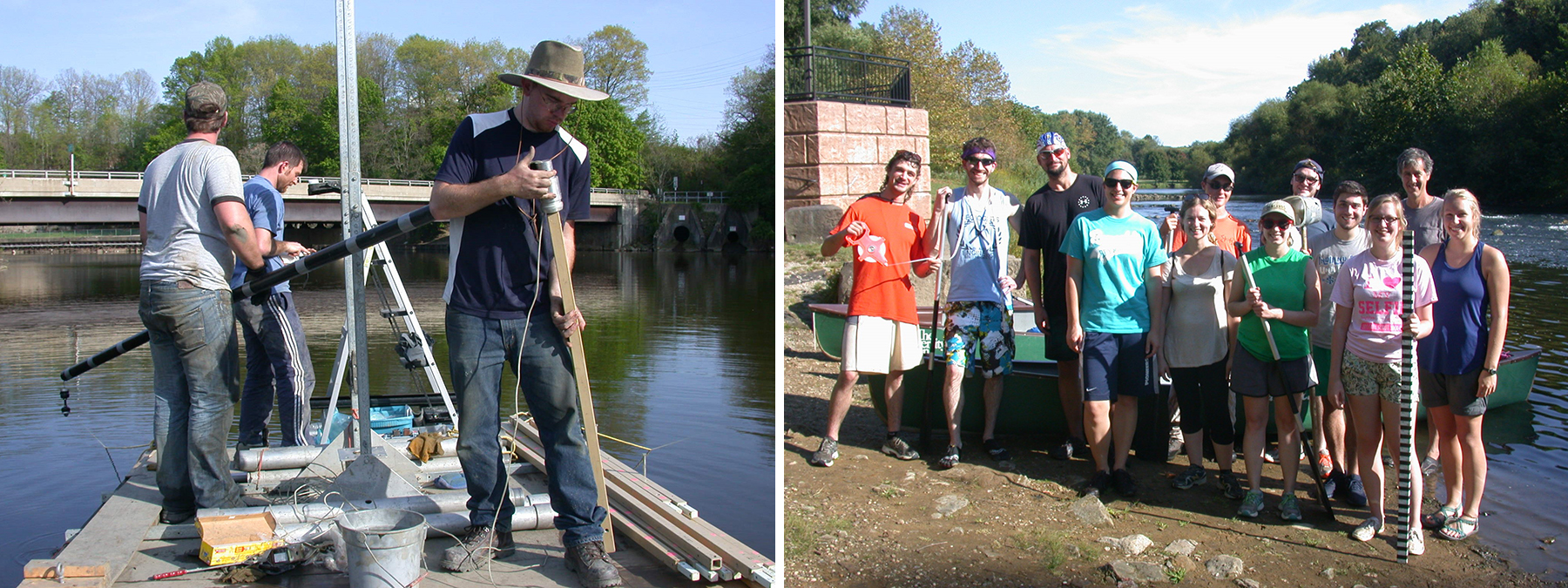
(left) Students obtaining a sediment core to study environmental change. (right) Rivers seminar students on a 10-hour long canoe trip down the Cuyahoga River to gather data.
Publications
Selected Publications
Anthropogenic Environmental Science
Mann, K.C., Peck, J.A. and Peck, M.C., 2013. Assessing dam pool sediment for understanding past, present and future watershed dynamics: An example from the Cuyahoga River, Ohio. Anthropocene, 2, 76-88. http://dx.doi.org/10.1016/j.ancene.2013.08.001
Peck, J.A. and Kasper, N.R. 2013. Multiyear assessment of the sedimentological impacts of the removal of the Munroe Falls Dam on the middle Cuyahoga River, Ohio. In: The Challenges of Dam Removal, eds. DeGraff, J.V. and Evans, J.E., Reviews in Engineering Geology, The Geological Society of America, pp. 81-92.
Bates, D. and Peck, J, 2012. Using Ground Penetrating Radar to Find the Pinery Feeder Dam in the Cuyahoga River, Summit County, Ohio. Towpaths, The Journal of the Canal Society of Ohio, vol. L, No. 3, 33-41.
Peck, J.A. and Bates, D., 2010. Seismic study of Gorge Dam pool sediments: Final Report to Ohio EPA and Friends of the Crooked River & Ohio EPA. 28pp. plus Appendices.
Bates, D. and Peck, J.A. 2010. A ground penetrating radar survey to find and delineate the Pinery Feeder Dam in the Cuyahoga River, near Ohio State Route 82: Final Report to U.S. Cuyahoga Valley National Park, Ohio EPA, and Friends of the Crooked River. 45 pp.
Rumschlag, J.H. and Peck, J.A. 2007. Short-term sediment and morphologic response of the middle Cuyahoga River to the removal of the Munroe Falls Dam, Summit County, Ohio. J. Great Lakes Research, 33 (Special Issue 2): 142-153.
Peck, J.A., Mullen, A., Moore, A., and Rumschlag, J.H., 2007 The legacy sediment record within the Munroe Falls dam pool, Cuyahoga River, Summit County, Ohio. J. Great Lakes Research, 33 (Special Issue 2): 127-141.
Magnetics
Yoonessi, M., Lerch, B.A., Peck, J.A., Rodgers, R.B., Sola-Lopez, J. and Meador, M.A., 2015. Self-healing of core shell magnetic polystyrene nanocomposites. ASC Applied Materials & Interfaces, 7, 16932-16937, DOI: 10.1021/acsami.5b04314.
Yoonessi, M., Gaier, J.R., Peck, J.A. and Meador, M.A., 2015. Controlled direction of electrical and mechanical properties in nickel tethered graphene polyimide nanocomposites using magnetic field. Carbon, 84, 375-382.
Yoonessi, M., Scheiman, D.A., Dittler, M., Peck, J.A., Liavsky, J., Gaier, J.R. and Meador, M.M. 2013. High-temperature multifunctional magnetoactive nickel graphene polyimide nanocomposites. Polymer, v. 54, no. 11, 2776-2784.
Yoonessi, M., Peck, J.A., Bail, J.L., Rogers, R.B., Lerch, B.A. and Meador, M.M. 2011. Transparent large-strain thermoplastic polyurethane magnetoactive nanocomposites. ASC Applied Materials & Interfaces, American Chemical Society. Doi.org/10.1021/am200468t, Vol. 3, No. 7, 2686-2693.
Kravchinsky, V.A., Evans, M.E., Peck, J.A., Sakai, H., Krainov, M.A., King, J.W., and Kuzmin, M.I., 2007. A 640 kyr geomagnetic and paleomagnetic record from Lake Baikal sediments, Geophysical J. Int.. doi: 10.1111/j.1365-246X.2007.03411.x. Vol. 170, p. 101-116.
King, J.W. and Peck, J.A., 2001. Use of paleomagnetism in studies of lake sediments. In Tracking Environmental Change Using Lake Sediments Volume 1: Basin Analysis, Coring, and Chronological Techniques, eds. Last, W.M. and Smol, J.P., Kluwer Academic Publishers, pp. 371-390.
Williams, D.F., Peck, J.A., Karabanov, E., Prokopenko, A., Kravchinsky, V.A., King, J., and Kuzmin, M., 1997. Lake Baikal record of continental climate response to orbital insolation during the past 5 million years, Science, 278, 1114-1117, 1997.
Peck, J.A. and King, J.W., Magnetofossils in the sediment of Lake Baikal, Siberia, Earth and Planetary Science Letters, 140, 159-172, 1996.
Peck, J.A., King, J.W., Colman, S.M. and Kravchinsky, V.A., 1996. An 84 kyr paleomagnetic record from the sediments of Lake Baikal, Siberia, Journal of Geophysical Research, 101, 11,365-11,385.
Paleoclimate
Shanahan, T.M., Hughen, K.A., McKay, N., Overpeck, J.T., Scholz, C., Gosling, W.D., Miller, C.S., Peck, J.A., King, J.W. and Heil, C.W., 2016. CO2 and fire influence tropical ecosystem stability in response to climate change, Scientific Reports, 6, 29587; doi: 10.1038/srep29587.
Shanahan, T.M., Peck, J.A., McKay, N., Heil Jr., C.W., King, J., Forman, S.L., Hoffmann, D.L., Richards, D.A., Overpeck, J.T., Scholz, C., 2013. Age models for long lacustrine sediment records using multiple dating approaches – an example from Lake Bosumtwi, Ghana, Quaternary Geochronology, v. 15, 47-60.
Shanahan, T.M., Overpeck, J.T., Anchukaitis, K., Beck, J.W., Cole, J.E., Dettman, D., Peck J.A., Scholz, C.A., King J.W., 2009. Atlantic forcing of persistent drought in West Africa, Science, 324, 377, DOI:10.1126/science.1166352.
Scholz, C.A., Johnson, T.C., Cohen, A.S., King, J.W., Peck, J., Overpeck, J.T., Talbot, M.R., Brown, E.T., Kalindekafe, L., Amoako, P.Y.O., Lyons, R.P., Shanahan, T.M., Castenada, I.S., Heil, C.W., Forman, S.L., McHargue, L.R., Beuning, K.R., Gomez, J., and Pierson, J. 2007. East African megadroughts between 135 and 75 thousand years ago and bearing on early-modern human origins. Proceedings of the National Academy of Sciences. Doi/10.1073/pnas.0703874104, Vol. 104, No. 42, p. 16416-16421.
Shanahan, T.M., Overpeck, J.T., Beck, J.W., Pigati, J.A., Talbot, M.R., Scholz, C.A., Peck J.A., King J.W., 2006. Paleoclimatic variations in West Africa from a record of late Pleistocene and Holocene lake level stands of Lake Bosumtwi, Ghana. Palaeogeography, Palaeoclimatology, Palaeoecology. 242, 287-302.
Brooks, K., Scholz, C.A., King, J.W., Peck, J., Overpeck, J.T., and Amoako, P.Y.O., 2005. Late-quaternary lowstands of Lake Bosumtwi, Ghana: Evidence from high-resolution seismic reflection and sediment core data. Palaeogeography, Palaeoclimatology, Palaeoecology. 216, 235-249.
Koeberl, C., Peck, J., King, J., Milkereit, B., Overpeck, J., and Scholz, C., 2005. The ICDP Lake Bosumtwi Drilling Project: A First Report. Scientific Drilling, vol. 1, no. 1, p. 23-27. doi:10.2204/iodp.sd.1.04.2005.
Peck, J.A., Green, R.R., Shanahan, T., King, J.W., Overpeck, J.T., and Scholz, C.A., 2004. A magnetic mineral record of Late Quaternary tropical climate variability from Lake Bosumtwi, Ghana. Palaeogeography, Palaeoclimatology, Palaeoecology. 215, 37-57.
Sapota, T., Aldahan, A., Possnert, G., Peck, J., King, J., Prokopenko, A., and Kuzmin, M. 2004. A late Cenozoic Earth’s crust and climate dynamics record from Lake Baikal. Journal of Paleolimnology. 32, 341-349.
Fowell, S.J., Hansen, B.C.S., Peck, J.A., Khosbayar, P., and Ganbold, Enebish, 2003. Mid to Late Holocene Paleoclimate Evolution of the Lake Telmen Basin, Northcentral Mongolia, Based on Palynological Data, Quaternary Research, 59, 353-363.
Peck, J.A., Khosbayar, P., Fowell, S.J., Pearce, R.B., Aurienbyleg, K., Hansen, B.C.S., and Soninkhishig, N. 2002. Mid to Late Holocene climate change in northcentral Mongolia as recorded in the sediments of Lake Telmen, Palaeogeography, Palaeoclimatology, Palaeoecology. 182, 135-153.
Prokopenko, A.A., Williams, D.F., Kuzmin, M.I., Karabanov, E.B., Khursevich, G.K., Peck, J.A., 2002. Muted climate variations in continental Siberia during the mid-Pleistocene epoch, Nature, 418, 65-68.
Prokopenko, A.A., Karabanov, E.B., Williams, D.F., Shackleton, N.J., Crowhurst, S.J., Peck, J.A., Gvozdkov, A.N., and King, J.W., 2001. Biogenic silica record of the Lake Baikal response to climatic forcing during the Brunhes, Quaternary Research, 55, 123-133.
Colman, S.M., Peck, J.A., Hatton, J., Karabanov, E.B., and King, J.W., 1999. Biogenic silica records from the BDP93 drill site and adjacent areas of the Selenga Delta, Lake Baikal, Siberia. Journal of Paleolimnology, 21, 9-17.
Aldahan, A., Possnert, G., Peck, J., King, J. and Colman, S., 1999. Linking the 10 Be continental record of Lake Baikal to marine and ice archives of the last 50 Ka: Implications for the global dust-aerosol input, Geophysical Research Letters, 26, 2885-2888.
Fowell, S.J. and Peck, J.A., 1997. Data collected in Mongolia offer key clues to past climate, EOS, 78, 320-321.
Colman, S.M., Jones, G.A., Rubin, M., King, J.W, Peck, J.A., and Orem, W., 1996. AMS radiocarbon analyses from Lake Baikal, Siberia: Challenges of dating sediments from a large, oligotrophic lake, Quaternary Geochronology, (Quaternary Science Reviews) 15, 669-684.
Colman, S.M., Peck, J.A., Likhoshway, E.V., Granina, L.Z., Karabanov, E.B., Carter, S.J., King, J.W., and Williams, D.F., 1995. Continental climate response to orbital forcing: The diatom paleoproductivity record from Lake Baikal, Siberia, Nature, 378, 769-771.
Peck, J.A., King, J.W., Colman, S.M., and Kravchinsky, V.A., 1994. A rock-magnetic record from Lake Baikal, Siberia: Evidence for Late Quaternary climate change, Earth and Planetary Science Letters, 122, 221-238.
Coastal Geology
Lacey, B. and Peck, J.A., 1998. Long-term beach profile variations along the south shore of Rhode Island, USA, Journal of Coastal Research, 14, 4, 1255-1264.
Roman, C.T., Peck, J.A., Allen, J.R., King, J.W., and Appleby, P.G., 1997. Accretion of a New England salt marsh in response to inlet migration, storms, and sea-level-rise, Estuarine, Coastal and Shelf Science, 45, 717-727.
Peck, J.A. and McMaster, R.L., 1991. Stratigraphy and geologic history of Quaternary sediments in lower West Passage, Narragansett Bay, Rhode Island, Journal of Coastal Research, Special Issue 11, 25-37.
Education
Ph.D. 1995, Graduate School of Oceanography - University of Rhode Island
Courses
- Physical Geology (3370:101)
- Sedimentation and Stratigraphy (3370:324)
- Coastal Geology (3370:421/521)
- Environmental Magnetism (3370:444/544)
- Field Camp I (3370:493/593)
- Paleoclimatology Seminar in Geology (3370:680)
- Rivers Seminar (3370:498)
- Independent Research (3370:499) and Honors Thesis (3370:497)