
Tiered Mentoring
with The University of Akron Department of Biology
Quantifying Pressures Exerted on the Shoulder by Different Guide Dog Harnesses
Rachel Olson, PhD, Moriah Wood, PhD candidate
Research background:
Guide dogs are specially trained to assist and support the independence of people who are blind or visually impaired. Guide dogs are trained to lead their handler around obstacles, identify stairs and street curbs, and safely maneuver sidewalks and street crossings. Often the handler and dog must communicate to ensure safe mobility. For instance, while the dog may be able to identify the start of a cross walk, the handler must also communicate when it is safe to cross. The handler communicates with their guide dog through their harness. There are several common types of harnesses used for guide dogs, all of which have a handle for the handler to hold onto and give signals to the guide dog by releasing or adding pressure. Most guide dog harnesses run horizontally across the chest, while others have a “Y” shaped design to accommodate shoulder movements. Some speculate that certain harness designs may affect the range of motion at the shoulder, but no studies have quantified the pressure that different harnesses are exerting on the shoulder.
Project details:
- Goal: To quantify the pressure that each harness exerts on the shoulder joint and to analyze changes in joint angles across harness types.
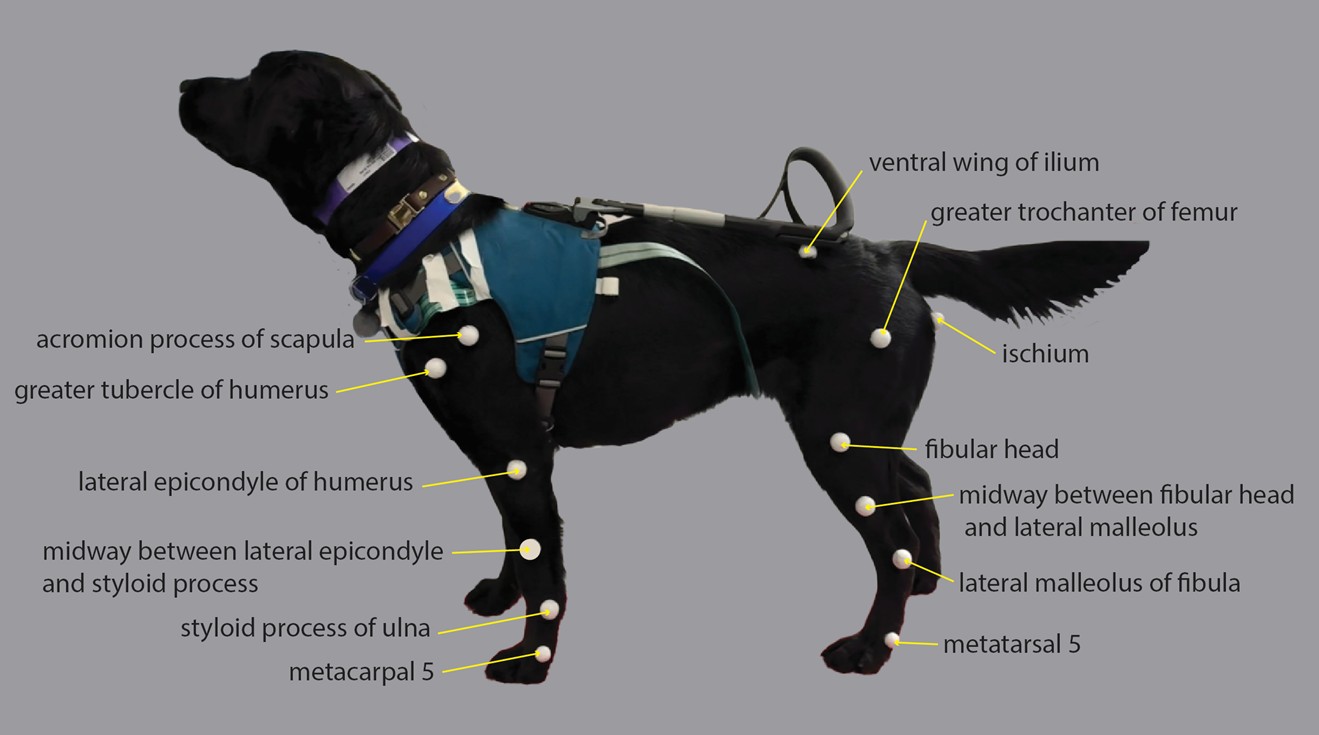
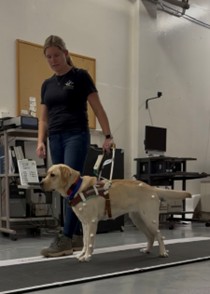
- Methods: 8 guide dogs (yellow and black labs) were recorded in 4 different types of harnesses, with markers attached to bony landmarks on the forelimb and hindlimb. The movement of these markers will be tracked in XMALab. Using the movements of these markers, we will be able to visualize differences in shoulder joint angles across harnesses.
Benefits for the Student:
- Learn about the basic principles of biomechanics, working dogs, and motion capture
- Receive training on video processing techniques through various software programs, including XMALab and RStudio.
- Participants have the potential to gain experience in science communication and public speaking, scientific writing, data management, and statistical analysis through presentations.
Qualifications:
We are looking for an undergraduate student of any major who is excited and willing to learn the above skills. Prior computer modeling experience is not required, and we are happy to teach you everything you need to know! If you are interested in learning more about working dogs, biomechanics, and motion capture, please consider joining our research.