Protecting Ohio communities, one cyber lesson at a time
Chinonso Nneji is one of 16 UA students who have participated in OCRI's Persistent Cybersecurity Clinic Internship Program (PCCIP). The program connects college students across Ohio with local government entities, giving them practical experience while helping communities strengthen their cybersecurity readiness.
A short password you put in your notes app. An ignored security update. An innocent email that reads, "Click here." For local governments, even seemingly small cybersecurity risks can have significant consequences for the communities that depend on their services.
That’s the lesson Chinonso Nneji is delivering firsthand through a paid internship with the Ohio Cyber Range Institute (OCRI), where he works with local government municipalities to assess their cybersecurity practices and identify opportunities for improvement.
A University of Akron senior majoring in computer information systems with a concentration in cybersecurity, and minoring in software development, Nneji is one of 16 UA students who have participated in OCRI's Persistent Cybersecurity Clinic Internship Program (PCCIP). The program connects college students across Ohio with local government entities, giving them practical experience while helping communities strengthen their cybersecurity readiness.
For Nneji, the opportunity brings together his interest in cybersecurity and his desire to make a difference beyond the classroom.
“I saw this as an opportunity to apply my technical knowledge to real-world challenges while contributing to something meaningful,” said Nneji, who comes to UA by way of Nigeria. “Being part of an initiative that helps protect organizations and the communities they serve is both professionally rewarding and personally fulfilling.”
Putting cybersecurity knowledge into practice
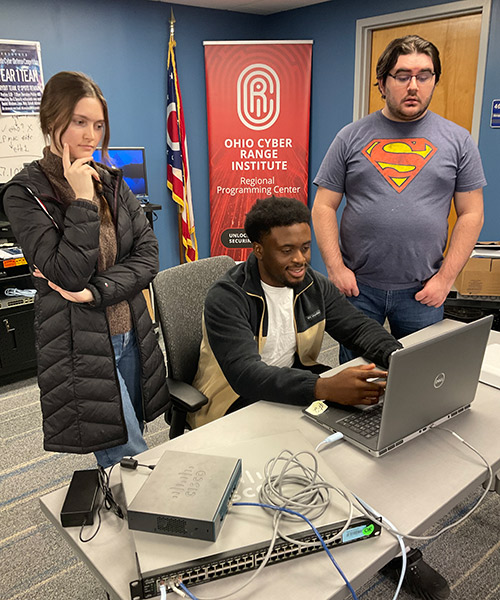
Chinonso Nneji (center) demonstrates the OCRI program’s workflow to fellow students interested in the program.
The paid internships supports OCRI's Ohio Persistent Cyber Improvement (O-PCI) program, which provides free cybersecurity training to local government entities. Working in teams, interns complete training to prepare them to engage with government representatives, present cybersecurity awareness information and help organizations identify ways to improve their security practices.
The initiative helps address cybersecurity needs at the local government level while expanding opportunities for Ohio college students to develop professional skills.
UA participates through its role as a Regional Programming Center within OCRI's statewide network, which brings together higher education institutions and other partners to advance cybersecurity education, workforce development and economic vitality.
Nneji describes his role as similar to that of a cybersecurity consultant, working alongside local government representatives to understand their existing practices, recognize potential security gaps and help identify practical improvements.
Each organization presents different circumstances and challenges, he said. Factors such as available resources, employee awareness and existing technology infrastructure all influence the cybersecurity solutions an organization can realistically implement.
“One of the most valuable aspects of my responsibilities is learning how to approach cybersecurity from both a technical and organizational perspective,” Nneji said. “It is not simply about identifying vulnerabilities; it is also about understanding an organization's needs and helping it take realistic steps toward improving its overall security posture.”
UA initially recruited eight students for the program's first phase over the summer. Following positive feedback about the students' performance, the university was asked to recruit an additional eight, bringing UA's participation to 16.
“This program creates a valuable connection between workforce development and community impact,” said Stanley Smith, professor of cyber forensics and Cyber Range Regional Programming Center coordinator at The University of Akron. “Our students are gaining practical experience applying their cybersecurity knowledge to real-world challenges, while helping local governments strengthen their ability to recognize and respond to cyber threats. It's an opportunity for students to grow professionally while making a meaningful difference across Ohio.”
Strengthening skills and building awareness
Nneji has seen firsthand that cybersecurity is not solely the responsibility of IT professionals. Everyone in an organization plays a role in protecting information and systems, and even small actions can make a difference.
“Everyone within an organization has a role to play in maintaining security, even if that role involves something as simple as enabling multifactor authentication or recognizing suspicious emails,” Nneji said.
His coursework at UA has given him a foundation in cybersecurity concepts and practices, while the internship has shown him the importance of making that knowledge accessible to others.

Student and OCRI intern Chinonso Nneji (left) with Professor Stanley Smith.
“I have learned that being knowledgeable about cybersecurity is important, but being able to communicate that knowledge effectively is just as valuable,” he said.
That lesson is one Nneji hopes to pass along as he prepares to mentor incoming UA interns next semester. Expected to graduate in December 2027, he plans to pursue a career in network engineering or cybersecurity and sees the mentoring opportunity as another way to help others grow in the field.
“One of the most important responsibilities of a mentor is understanding where someone currently stands in their technical development and helping them progress from there,” Nneji said. “I believe effective mentorship is not about demonstrating how much you know, but rather about making your knowledge accessible to others.”
Through opportunities to learn, lead and mentor others, Nneji himself is helping strengthen both Ohio's cybersecurity readiness and the future workforce.
UA was the first public university in Ohio to offer a bachelor’s degree in computer information systems with a focus in cybersecurity. It is among the first cybersecurity degree tracks in the U.S. that includes courses in digital forensics and applied cryptography (the science of encrypting messages), which are typically offered at the graduate level.
Learn more about computer and technology degrees at UA.
Story by Alex Knisely
Media contact: media@uakron.edu