2026 Schedule
- Industry Panel
- Session 1
- Session 2
- Session 3
- Keynote
- Session 4
- Session 5
- Session 6
- Session 7
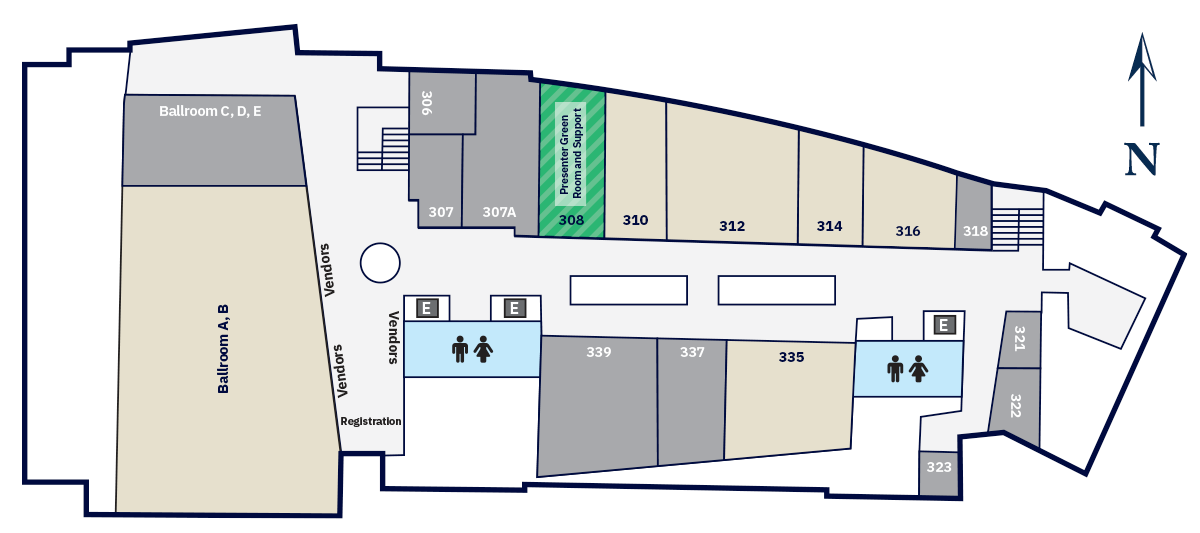
- Closing & Map
Breakfast & Registration Outside Ballroom A - 7:30am - 8:15am
Welcome & Introduction Ballroom A - 8:15am - 8:30am
Industry Panel Ballroom A - 8:30am - 9:30am
From Campus to Career: Assessing What Matters When AI Is Everywhere
Dr. Alexa Fox, The University of Akron
Lakisha Barclay, Rubber Division, ACS
Bacari K. Brown, SuperHuman and,
Bobby Hancock, Westfield Insurance
This panel session brings employer voices into the conversation about what “real skill” looks like now. As AI tools become commonplace in the workplace, this panel explores the competencies organizations most need—critical thinking, communication, collaboration, ethical judgment, and the ability to apply knowledge in context—and how those show up (or don’t) in traditional academic assessments. Panelists will share how their industries are adapting hiring, onboarding, and performance expectations in an AI-enabled environment, and what evidence of learning best signals career readiness. Attendees will leave with concrete ideas for designing authentic assessments that translate beyond the classroom while strengthening trust and integrity.
Back to top
Session 1 9:45am - 10:15am
Room 310
Geometry and Gen-AI-try: Combining Automated Reasoning with Mathematical Reasoning
Dr. Jeffrey Smith, Otterbein University
Discover how GenAI brings to light obscure geometry conjectures and how students critically interpret Euclidean statements to sketch accurate visuals using dynamic cyber tools. Student work samples reveal the journey from AI-generated ideas to rigorous mathematical proof.
Room 312
Why AI Successfully Completing Assessments is Actually Good
Dr. Eric de Araujo, Purdue University
Instead of AI-proofing our assessments, we should want AI to successfully complete them. Why? Because the prompting work required to achieve high-quality outputs is diagnostically valuable. I show how the prompt gap can help instructors design authentic, transparent assessments.
Room 314
An Ethical Framework for AI Policy in Education
Charlie Landers, Western Reserve Academy
AI is revolutionizing modern society and educators can responsibly navigate these advancements. This presentation explores how five key ethical principles (Transparency, Empowerment, Fairness, Accountability, and Privacy) can guide AI policy and decision-making in education.
Room 316
Implement AI Policy AND Improve the Student AND the Instructor Experience
Dr. Stephen Craig, University of Mount Union and, Mo Zadeh, Rumi Technologies Inc.
Students once feared AI use would mean cheating. Today’s tools are fragmented and AI detectors often cause false accusations. Instead of bans or surveillance, transparency, showing how work was written through revision history, allows flexible AI policies and authentic assessment on an assignment-by-assignment basis.
Room 335
The Authenticity Lab: Crafting "Un-Googlable" Tasks with NotebookLM, ChatGPT, and Gemini
Page Durham, LearnAIID, LLC
Ditch the AI detectors and start designing. In this hands-on lab, we’ll use NotebookLM, ChatGPT, and Gemini to transform static assignments into "un-googlable" authentic assessments. Focus on the process, prioritize integrity, and leave with a future-proofed activity.
Back to top
Session 2 10:30am - 11:00am
Room 310
Artificial Intelligence (AI)-Driven Simulation Platform to Rehearse Core Teaching Practices
Dr. Minsung Kwon, California State University, Northridge
Learn how AI-powered simulations transform teacher training by overcoming cost, scalability, and accessibility barriers of traditional methods. This session showcases an innovative ChatGPT-integrated platform that maintains authentic teaching practice while enabling widespread access.
Room 312
Authenticity in Action: Teaching Strategies for Retention and Belonging
Dr. Elena Popa, Dr. Daniela Jauk-Ajamie, Dr. Stacia Biddle, Stephanie Kiba and, Jenny Hebert, The University of Akron
In this interactive session, the audience is introduced to the Persistence Project, a set of teaching strategies that create a relationship-rich environment conducive to authenticity in the classroom.
Room 314
The Human Touch & the AI Hand: Reaffirming Faculty Value While Ethically Integrating AI in Assessment
LeighAnn Tomaswick, Kent State University
Reaffirm your expertise and value in the age of AI. Learn to use GAI ethically in assessment design and grading—not to replace, but to empower. Develop a clear line on when you’ll use GAI and ensure human judgement remains central to your work.
Room 316
Student Perceptions of AI Policy in First-Year Public Speaking: Implications for Learning and Engagement
Dr. Rhiannon B. Kallis and Dr. Yang Lin, The University of Akron
This session examines first-year public speaking students’ perceptions of AI policy, including benefits, risks, and ethical use of tools like ChatGPT. We'll discuss strategies for clear guidance, authentic assessment, and student engagement in AI-integrated teaching and learning.
Room 335
Designing AI-Proof Assessments: A Hands-On Workshop for Creating Innovative Assessments in the Age of AI
Dr. Andrea Meluch & Jeff Klemm, The University of Akron
This hands-on workshop explores innovative assessment strategies for college courses in the age of AI. Participants will create actionable plans for their own courses to develop authentic assessments.
Back to top
Session 3 11:15am - 11:45am
Room 310
Exploring the AI-Human Relationship in Research Practices
Dr. Samaa Haniya, Pepperdine University
The presentation will showcase specific AI research tools, present findings of a case study of a graduate course, and offer actionable recommendations for faculty to integrate generative AI responsibly.
Room 312
Exploring Utility of AI as an Archival Tool: A Class Investigation to Inform University Libraries Collection Development
Dr. Jodi Kearns, Dr. Aimée DeChambeau, Drew Bayer and, Michael Toth, The University of Akron
Students observe and quantify effectiveness of using AI for completing tasks in metadata generation and transcription compared to their own completion of the same tasks essential for access to archival documents. Students prepare a data-driven report to Dean of Libraries to inform AI use in archives
Room 314
Experience AI in Business: An Asynchronous Framework for Applied Artificial Intelligence Education
Dr. Bang An, The University of Akron
This proposal presents an asynchronous online course, Experience AI in Business, designed around the AAA Standards, Accessible, Adaptable, and Affordable—to help students understand AI concepts, identify business opportunities, and apply LLMs and AI tools to solve real-world problems.
Room 316
Case Study in Dialogue-Based Assessment Using AI Agents
Dr. Dana Riger, University of North Carolina at Chapel Hill
A case study of a dialogue-based assessment using AI agents as rehearsal tools to support authentic learning. Explore lessons learned and practical ways to use agent collaboration for skill-based assessment.
Room 335
"Questfolios": Roleplay + ePortfolios as Authentic Assessment in the Age of AI
Garrett Munro, Cuyahoga Community College
Questfolios blend roleplay and ePortfolios to create authentic, AI-resistant assessments. Students adopt roles, reflect through multimodal artifacts, and showcase growth. This session offers models, prompts, and hands-on design to help educators implement Questfolios.
Back to top
Lunch & KeynoteBallroom A - 11:45am - 1:15pm
When Assessment Ends: Designing Teaching and Learning After AI 12:25pm - 1:15pm
Dr. Patrick Dempsey, Founder and Co-CEO Pend AI
As AI makes many traditional measures of individual performance unreliable or irrelevant, attempts to “return” to pre-AI practices or intensify surveillance miss the larger opportunity now in front of us.
This keynote argues that the collapse of traditional assessment is not a failure to correct, but a signal to listen to. Drawing on the history of standardized assessment; observations from authentic learning environments; and insights into how complex, real-world problems are actually solved, the session shows how AI disrupts assessment practices built around proxies for learning—practices that were never designed to surface cognition, judgment, or transfer.
Rather than framing AI as a threat to academic integrity, this talk positions AI as a catalyst for shifting attention from measuring outputs after the fact to intentionally designing the conditions under which learning becomes visible as it unfolds.
The keynote concludes by outlining a design-forward approach to teaching and learning in the AI era: creating meaningful contexts for challenge, providing human support where it matters most, and equipping learners with heuristics that strengthen judgment as problems emerge.
Back to top
Session 4 1:30pm - 2:00pm
Room 310
Building a Framework of Ethical Generative-AI Use for Academic Writing: Using Student Survey Data to Develop Resources for Writing Instruction
Dr. Diana Awad Scrocco, Youngstown State University
To teach the writing process in an era of generative AI, we must understand students’ perceptions of AI and select pedagogical practices that demotivate unethical AI use. The speakers offer writing-instruction frameworks, AI-commitment forms, AI syllabus policies, and faculty workshop outlines.
Room 312
Developing Metacognition Through LLM-Enhanced Writing Assignments
Dr. Dimitria Gatzia & Moriah Wood, The University of Akron
We discuss the design of LLM-integrated assignments that promote responsible LLM usage among students and leverage metacognitive strategies to strengthen critical thinking skills.
Room 314
It's a Human Problem, Not a Technology Problem: Dealing with AI Use in Student Writing
Dr. Jay L. Gordon, Youngstown State University
Inappropriate student use of AI tools such as ChatGPT and Grammarly is a human problem, not a technology problem. In that light, my AI policy involves requiring a face-to-face meeting before entering a grade for their work. This approach is not perfect, but it has worked well in my writing classes.
Room 316
From Detection to Connection: Building Assessments In the Age of AI That Students Actually Want to Do
Dr. Amanda Pacheco, University of Central Florida
Ditch the AI-detectors, and build courses where students don't want to cheat. This workshop offers practical, research-grounded strategies for designing authentic assessments that motivate through choice, challenge, and connection.
Room 335
Creating and Delivering Collaborative Synchronous Class Lectures Using Miro
Dustin Muncy, University of Cincinnati - College of Nursing
This presentation focuses on the interactive whiteboard tool, Miro, and how you can use it to allow students to co-create lectures with you in a synchronous learning environment. You'll review a real classroom case study with student submissions and be provided with a Miro Lecture Creation Guide.
Back to top
Session 5 2:15pm - 2:45pm
Room 310
One Degree of Separation: Designing Assessments to Deter GAI Cheating & Foster Critical Thinking
LeighAnn Tomaswick, Kent State University
Learn the “One Degree of Separation” strategy to deter GAI cheating. Reframe assessments to make AI a tool for higher-order thinking and integrity, rather than a tool for deception. Stop reacting and start designing! Join us to explore this strategy and come away with practical examples.
Room 312
Confronting AI in Community
Sarah Beal, Bruce Mandeville, Dr. Leesa Kern, Dr. Katie Wissman and, Dr. Stephen Crumb, Otterbein University
In this panel, a community of faculty from various disciplines will share how learning about AI tools in community has allowed them to more deeply explore their own values around generative AI and develop effective approaches to AI in their teaching.
Room 314
Using CATME to Better Manage and Assess Teams to Improve Experiences
Dr. Siqing Wei, Youngstown State University
This workshop will introduce a web-based team management tool, CATME. Following the state-of-art scientific findings, this tool suite could help instructors optimize team formation based on given criteria, and administrate teamwork evaluation and associated considerations.
Room 316
What the Sigma? Classroom Engagement Strategies for Generation Alpha
Stephanie Lenkey, St. Francis de Sales School, Toledo
The key to accelerated academic achievement lies in student engagement, but engaging the digital generation is a bigger challenge than ever! Participants will learn how Generation Alpha is "built different" as well as simple things they can do to engage all learners in their classroom.
Room 335
Integrity, Ethics, and Proper Use of AI: Managing Learning and Assessment in the World of Algorithmic Intelligence
Dr. Mark J. Carroll & Dr. Nikita Kuznetsov, The University of Cincinnati
This presentation examines the use of AI in educational settings, exploring its use as a resource for learning and discovery, as well as a potential tool for academic dishonesty. The presenter will discuss analysis of the ethical dimensions of assessment, and pedagogical and policy recommendations.
Back to top
Session 6 3:00pm - 3:30pm
Room 310
Using AI to Teach Its Own Limits: A Reflective Learning Project with the Big Five Personality Model
Ranjani Varaghur, The University of Akron
This activity is designed to build critical thinking, ethical awareness, and digital literacy by revealing the limits of AI. Students compare their Big Five personality self-assessments with AI-generated profiles to explore how AI interprets personality traits.
Room 312
Responsible AI Adoption in Higher Education: Trends, Challenges, and Opportunities
Lauren Houser, The University of Akron and, Casey Barton & Dustin Lange, McGraw Hill
AI is transforming higher education, driving rapid adoption across teaching, learning, and administration. This session covers trends, challenges, ethics, and AI literacy, and shows how McGraw Hill supports responsible AI to improve student success and reduce risk.
Room 314
Beyond the Prompt: Harnessing AI as a Semester-Long Teaching Partner
Jeffrey Pellegrino, The University of Akron
Discover how faculty can use AI as an ongoing learning tool, not just a one-off assignment. Learn scaffolded strategies, prompt design, and authentic assessment for project-based courses to make AI a continuous, value-added teaching partner all semester long.
Room 316
Humanizing Online Learning: A Hands-On Approach to Authentic Multimedia Assessment
Dr. Rachel Faerber-Ovaska & Stephanie Adams, Youngstown State University
Gen AI challenges traditional assessment. How can we authentically evaluate human learning? Come create a "Multimedia Process Wrapper" to support self-regulated learning. Use multimedia in Padlet/your LMS to humanize assessment and demonstrate learning. Leave with a ready-to-use template and rubric.
Room 335
Build Your Spidey Sense to Spot AI Writing Without Any Tools
David Grimes, The University of Akron
If student writing sometimes feels off, this session helps you sort through it. You will study short samples, spot signals of AI generated text, and learn wording to describe what you notice. Leave with a simple process that needs no tools.
Back to top
Session 7 3:45pm - 4:15pm
Room 310
Up Your Game with AI
Sarah Beal, Otterbein University
During this session, we will explore how GenAI tools can aid in the planning and development of classroom games that promote authentic learning experiences for students. Participants will leave with ideas for how they could use AI tools to support Game-Based Learning in their own contexts.
Room 312
A Workshop on How to Collaboratively Develop Ethical ChatGPT Guidelines with Students
Dr. Murat Dagistan, Kent State University
An interactive workshop exploring how to co-create ethical ChatGPT guidelines with students to foster trust, critical thinking, and digital responsibility in higher education classrooms.
Room 314
Redefining Authenticity in the Era of Large Language Models through Process-based Portfolio Assessment
Courtney Poullas, Youngstown State University
Portfolio-based assessment supports original student work and AI literacy by capturing the full learning process. Expanding its use across disciplines supports educators' ability to assess authenticity, guide ethical AI use, and foster independent, critical thinking.
Room 316
Conversations with the Past or Humanities of the Future? AI Personas, Primary Sources, and the Future of Assessment
Dr. Evi Gorogianni, The University of Akron
What if students could ask Hammurabi or Augustus anything? This project uses custom AI personas to bring ancient law and empire to life. Students dive into primary sources, build critical thinking and AI literacy, and experience a fresh, engaging model of authentic assessment.
Room 335
Putting the YOU in Assessment: Humanizing Feedback with Video & Audio Tools
Dr. Richard Smith, Cleveland State University
Discover how simple video and audio feedback techniques can transform your assessment practice. In this session, we’ll explore how multimedia feedback fosters stronger connections with students, improves clarity, and boosts engagement.
Back to top
Interactive Closing & Raffle Ballroom A - 4:25pm - 5:00pm3/h2>
Back to top